Polyvagal Theory, Part 2: Deepening Our Understanding

The previous article in this series (found here) provided an introduction to polyvagal theory. In this article, we’ll explore each of our three primary autonomic states a bit further.
As a reminder, these three states are:
(1) connection (living within our window of tolerance);
(2) fight-or-flight; and
(3) freeze.
Fight-or-flight and freeze are our two stages of protection mode.
We’ll start by looking at our capacity for safe connection.
***
Connection mode hinges on the activity of the ventral branch of our vagus nerve.
The ventral vagus emerges from the brainstem and links to our tongue, neck, throat, lungs, and heart. It allows us to communicate by innervating the tongue and voice box and it calms our heart and respiratory rates, soothing the rhythms in our chests.
We evolved as tribal animals, and it’s the ventral vagus nerve, in particular, that has enabled us to find a sense of safety by harmonizing with other nervous systems. Together with the facial nerves that control the eyes, ears, and head movements, the ventral vagus provides us with a “biological face-heart connection,” a “social engagement system.” This system makes it possible for us to express ourselves and to understand the expressions of others.
Deb Dana writes:
It is through this face-heart connection that we listen for sounds of welcome, look for friendly faces, and turn and tilt our heads in search of safety. Micro-movement to micro-movement, through our eyes, ears, voice, and head movements, our social engagement system broadcasts an invitation for connection with someone or sends them a warning to keep their distance. In addition to sending signals of welcome or warning, our social engagement system looks for signs from others to let us know it’s safe to come into connection. [i]
So, the ventral vagus helps us feel safe through ”syncing” with other nervous systems. But it also helps us feel connected even in the absence of other people!
We can “turn on” the heart-and-lung-soothing effects of the ventral vagus through such simple activities as smiling, laughing, singing, humming, and chanting.[ii] These types of activities promote ventral-vagal “tone” and serve as tools for us to self-soothe.
Even thinking about a beloved pet or person or place, or remembering a time we were supported or loved nourishes our ventral vagal network.
Our ventral vagal hardwire is present from birth, but engagement is required to activate it. This is where a nurturing caretaker comes in. Consider the way a parent coos and hums and sings to a newborn (like the one pictured at the top of this page), encouraging their little one to join in on the fun. Though they might not be aware of it, the parent is “training” the baby’s ventral vagus nerve.
But even if we didn’t have the good fortune of this early-life ventral vagal training, we can fortify this neural pathway as adults through the types of activities I’ve mentioned. It’s really quite a biological gift: The ventral vagus not only helps us feel supported externally (by recruiting the help of others), but it also helps us feel supported internally when we stimulate it regularly.
When ventral vagal activation is our “default setting,” we bolster our present-moment sense of safety and ease in the world. When we’re in ventral connection, we “play well” with others. Even when disagreeing, the ventral vagus keeps us in relationship, so that we can access diplomatic, relationship-based resolutions to conflicts. We feel engaged, creative, connected, optimistic, in the flow…even in the midst of challenges.
***
The development of the ventral branch of the vagus nerve provided mammals with an evolutionary advantage by giving us a sophisticated mode of operation that demands little of our visceral physiology. However, sometimes it’s not enough to feel connected—instead, we need fight or flee in order to stay alive.
In the fight-or-flight response, the brain registers that we need to mobilize resources for activity, and so it stimulates the adrenals to start pumping out stress hormones. Cortisol, epinephrine (adrenaline), and norepinephrine (noradrenaline) stir up a full-body arousal by constricting vessels and tensing muscles; speeding up our cardiac and respiratory rates; boosting blood sugar and fats to supply the body with extra energy; and suppressing the immune system.
We start to sweat in anticipation of the warmth of intense muscular activity. Our pupils dilate to provide greater visual capacity. Our digestion pauses, so that blood can be reserved for use in muscle activity. We’re ready for action!
In fight-or-flight, our up-wave shoots upward beyond the threshold of our window of tolerance, into protection mode:
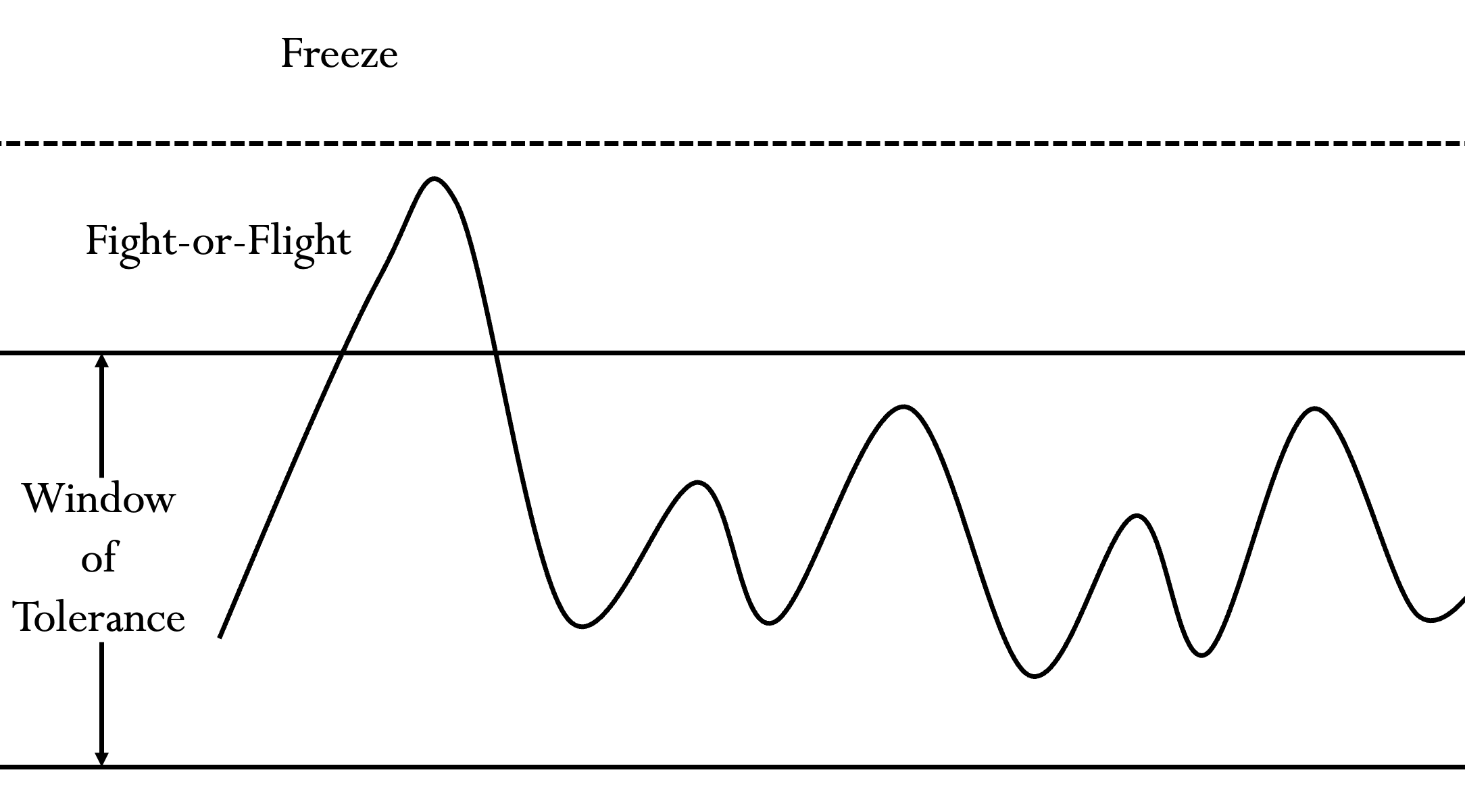
But what happens if this hyper-arousal fails to get us to safety? What if we’re overwhelmed by the threat—what if we’re pinned down in a car crash or overmatched by an assailant? This is where we turn to the reptilian response of freezing, our third strategy to deal with danger.
***
The freeze response is made possible by the dorsal (or “vegetative”) branch of the vagus nerve. In non-stressful times, the role of the dorsal vagus is to help us rest and digest—it governs the depth of our down-wave. This nerve stretches down to the organs of the belly, including the stomach, liver, intestines, and kidneys. When the dorsal vagus is in a “low-tone” state, it supports all our restorative functions, including sleep. The dorsal vagus is the Yin to our sympathetic Yang.
But when we’re faced with danger, and the fight-or-flight response isn’t getting us to safety, the dorsal vagus nerve becomes “high tone.” It ramps up its sedating effect, sending us into a state of paralysis, severely reducing our metabolism. Our digestive processing shuts down, our heart rate slows, and our breath becomes shallow. We might have a desire to evacuate the bowels or bladder. In extreme cases, we no longer register physical pain, or we might even faint.
While the ventral vagus gently brakes against sympathetic arousal, high-tone activation of the dorsal vagus slams those brakes. After all, hyper-arousal consumes our precious resources. If those resources aren’t getting us to safety, our autonomic nervous system cuts its losses and shuts us down.
Beyond energy conservation, this immobility response offered our ancestors several evolutionary advantages. Trauma psychologist Peter Levine details them like this:
First,…[i]mmobility is an imitation of death that misleads the predator into sensing that the meat may be bad. Through this deceptive act, the prey animal has a chance to escape. Second, predatory animals have greater difficulty detecting potential prey that are not moving…Third, if a predator comes upon a group of animals the collapse of an individual can distract the predator momentarily, allowing the rest of the herd to escape. Fourth, in a world where all animals are located somewhere in the food chain and may be either predator or prey, nature provides an analgesic mechanism for minimizing the pain suffered at death. [iii]
When the dorsal vagus is engaged as a survival response, there’s a spectrum of resulting states. As I mentioned in the previous article, at one end of the spectrum is the “braced freeze,” where we’re still quite energized. It’s like the gas and the brake are both pressed down. This is good for keeping us very still and quiet, yet still energetically activated.
On the other end of the spectrum is the “collapsed freeze,” where there’s no energy available. We’re shut down, limp, dissociated, foggy. We’re not totally here. We collapse to protect ourselves by removing our consciousness from an experience that’s simply too much to bear. Our awareness withdraws from the body.
***
So, these are our three primary autonomic states:
(1) ventral-vagal connection
(2) sympathetic hyper-arousal (fight-or-flight), and
(3) dorsal-vagal freeze.
Now, what happens after we've moved into protection mode and then accessed safety? How do we "flip the switch" back to connection mode? Well, when we reach safety, we have the opportunity to discharge any residual fight-or-flight energy—the mobilized charge that never got used. This might look like trembling, shaking, crying, a deep spontaneous exhale, or the urge to move that finally gets to complete itself. (Think of a gazelle, after outrunning a predator, visibly shuddering before it goes back to grazing.) Once this energy discharges, we naturally find ourselves back in connection mode.
Understanding these three states—connection, fight-or-flight, and freeze—isn't just an academic exercise. It's the groundwork for recognizing what's actually happening in your body moment to moment, rather than being at the mercy of it. And when discharge doesn't happen, when we get stuck in protection mode long after the danger has passed, that's the source of trauma—which is the subject of the next article in this series. Click here to continue our exploration.
***
[i] Dana D. Anchored: How to Befriend Your Nervous System Using Polyvagal Theory. Boulder, CO: Sounds True; 2021: 41.
[ii] See, for instance:
Vickhoff B, Malmgren H, Aström R, et al. Music structure determines heart rate variability of singers. Front Psychol. 2013; 4: 334.
Miller M, Fry WF. The effect of mirthful laughter on the human cardiovascular system. Med Hypotheses. November 2009; 73(5): 636.
[iii] Levine PA, Frederick A. Waking the Tiger: Healing Trauma. Berkeley, CA: North Atlantic Books; 1997: 96-97.